
By Wicked Salem
In this story
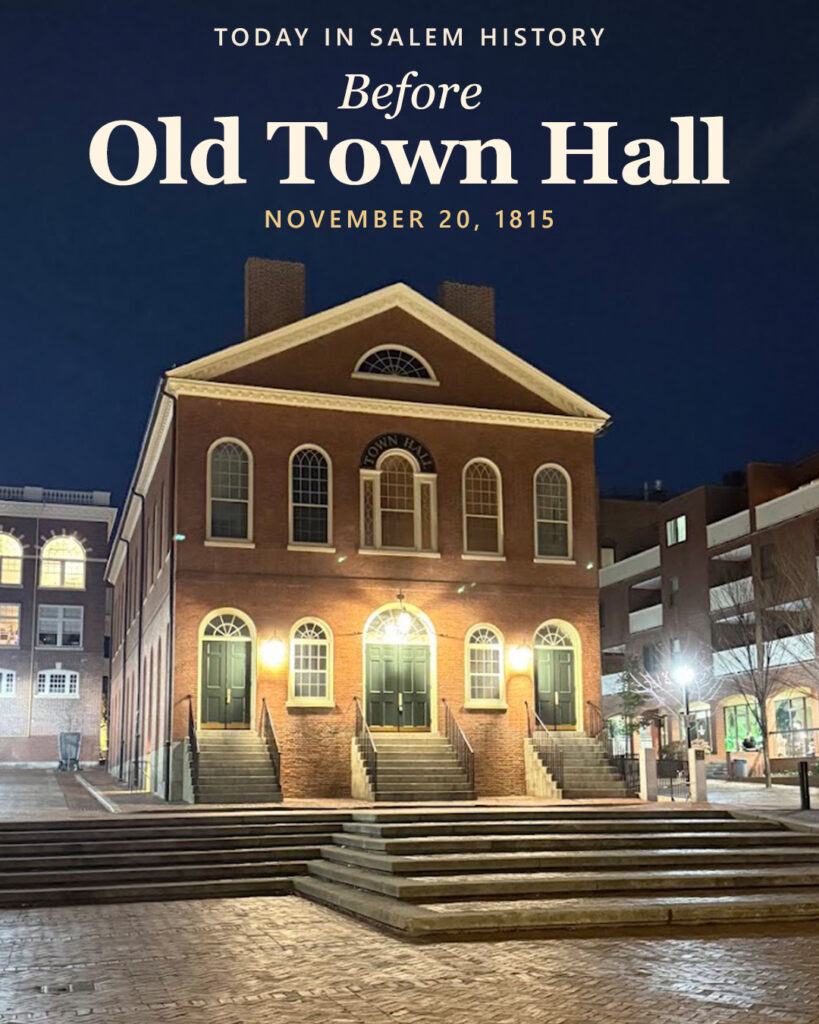
Stand at the foot of the steps in Derby Square after dark and you can see why people stop for a photo. The lamps light up the green doors and the brick above them. If you know the building from Hocus Pocus, you’re looking at the exterior used for the town Halloween party in the 1993 movie. In 1815, the steps on this site belonged to a merchant’s mansion, and they were made of marble.[1][2]
The house Bentley went to see
On November 20, 1815, the Rev. William Bentley went for one last look at the home of the late Elias Hasket Derby. He described a wooden mansion with marble steps, gardens that reached back toward Front Street, and plasterwork in a round room on the south side. It was the finest house he’d ever seen, he wrote.[2]
“I saw the front demolished & left it in ruins.”
Derby was one of Salem’s wealthiest merchants. His Essex Street mansion went up in the late 1790s and had 15 rooms, according to a National Park Service study of the house and its furnishings. Derby died in 1799. His eldest son later moved to Charlestown, and the mansion sat empty for several years. Bentley wrote that the heirs couldn’t agree to occupy it and that the site was well placed for other buildings.[3][2]
Market downstairs, public hall upstairs
John Derby and Benjamin Pickman Jr. planned a commercial square on the property and gave the town land in the middle for a market and a town hall. The brick building went up in 1816 and 1817. Its ground floor held the market stalls, and the upper floor gave Salem a public hall.[4]
Bentley wrote about the new market, too. On November 25, 1816, he described its first trial. The stalls were well supplied, and almost everyone bought something. A vendor named Sawyer said he sold nine quarters of beef from his stall. A year after Bentley had stood looking at the ruins, he was writing about neighbors coming to the same spot to buy food.[5]
The building was serving as Salem’s town hall by 1817, when it welcomed President James Monroe. Bentley described a hall decorated and lit for the occasion. Salem voters accepted the city charter in the same building in 1836, and it continued to house city government. Work on the present City Hall on Washington Street began in 1837. The City Council held its first meeting there on May 31, 1838.[6]
A piece of Derby’s garden is still in Salem
Behind the mansion once stood a little one-room summer house designed by Salem carver and architect Samuel McIntire. It overlooked the river and was built for light afternoon meals. You can find it today near the Peabody Essex Museum’s Federal Garden. The museum’s garden takes its cues from the old grounds, with roses, fruit trees and rhododendrons.[7]
Have a photo you took outside Old Town Hall? Share it in the comments below. We’ll feature some of your photos in a future Wicked Salem post or article and credit each photographer.
Sources
- Destination Salem, Hocus Pocus filming locations identifies Old Town Hall as the setting for the town Halloween party.
- William Bentley’s November 20, 1815 diary entry appears on printed page 35 of the National Park Service study, citing volume IV of the diary, page 362.
- National Park Service, the Essex Street mansion documents Derby’s death, the rooms and furnishings, and the family’s later use of the house.
- National Register of Historic Places, Downtown Salem District documents the land donation and the development of Derby Square. The Salem Heritage Trail’s Derby Square entry gives the building dates and the use of each floor.
- William Bentley’s November 25, 1816 diary entry, volume IV, printed page 423, describes the trial market and Sawyer’s sales.
- Bentley’s diary, volume IV, pages 464–465 describes Monroe’s visit. The Old Town Hall Historic District nomination dates the building’s use as Town Hall through 1838. The City of Salem’s historical profile records the charter vote at Old Town Hall, the start of construction on Washington Street and the first City Council meeting there.
- Peabody Essex Museum, Derby-Beebe Summer House documents McIntire’s garden building and its present location.
Bentley’s date refers to the front of the mansion he saw in ruins. The National Register dates the demolition to 1815. The museum’s history gives 1816 for the mansion’s final removal.
Leave a Reply